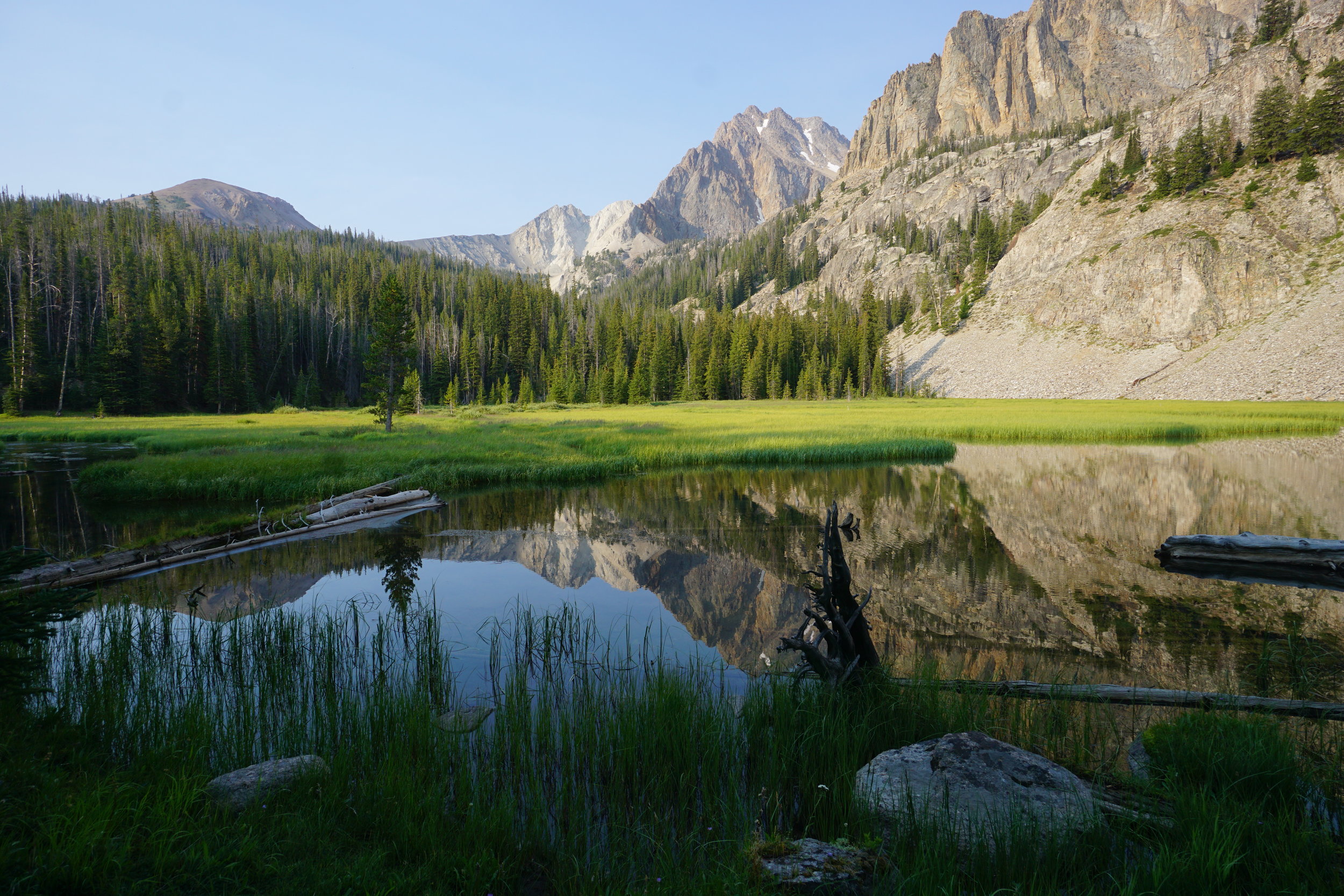
Titcomb Basin in Wind River Range, Wyoming

Just got back from a 7 day hike in the Wind River Range, to the Titcomb Basin.  Almost the whole trip was over 10,000′ elevation.  Our itinerary: Eklund Lake, Island Lake, Upper Titcomb Basin, layover day and day hike to top of Knapsack Pass, Island Pass, Upper Sweeney Lake, and to Elkhart trailhead.

This was a scout hike, and our three scouts were Tomio, Jim, and Malcolm.

Winds'2010 072.15

Before we got to Island, it clouded up and started raining.  We hiked in the rain for about 30 minutes, and set up our tents in the rain, then it cleared up about an hour later.  Tomio, Kevin, and Gary are shown as the wind picks up and the weather darkens before we hit Island Lake.

Winds'2010 109.16

Island Lake is below in the evening of the second day, after a brief but poorly timed rain.

Winds'2010 132.15

The third day we camped on the point of land below the upper Titcomb Lake, shown below.  This area seemed to be continually windy, but so scenic.

Winds'2010 191.20

The fourth day we day hiked to Mistake lake, a surprisingly large lake on a bench above Upper Titcomb Lake.  Then we hiked to the top of Knapsack Pass.  This a tough scramble up loose boulders and ice of the glacier, till we got to a vertical cornice of snow at the top of the pass.  We got around the cornice by a 4th class scramble to the right of the snow.  Below are me and two of the boys: Jim and Malcolm.  This is looking from the Pass toward Peak Lake, which is visible, to the right of Malcolm’s ear.

Winds'2010 209.20

We didn’t stay on top of the pass long, as it was already 2 PM and clouds were building. There was a 20 foot hairy section, which Jim is shown descending.

Winds'2010 212.20

We descended the glacier, and the loose talus and boulders of the terminal moraine, and headed back to camp.  Below is a view of two of our guys between the two big glacial eratics, with the upper and lower Titcomb lakes in the background.

Winds'2010 215.20

Gary heads up the hill out of Island lake, and we head for the nights camp at Upper Sweeney Lake.  This is our last look at Island lake.

Winds'2010 236.20

Baking Pizza on a Caldera Cone and Stove / Outback Oven

On a July hike to Imogene Lake I tried making pizza using the Caldera Stove and the Outback Oven.  These two make a nice combination for baking any bread or cake.

This is a view of the ingredients in the bag, and the Caldera Cone Ti Tri assembled.  My version uses a cup of Jiffy pizza mix, pepperoni in a little baggie, Boboli tomato sauce in a bag, string cheese, olive oil and dried garlic.  The recipe is below.

P1010045.26

The first step is to mix up the pizza mix with water, and cut up the pepperoni and cheese into bite sized chunks.   The pizza dough should be kind of thick, not pourable, but this makes it a little hard to spread out to cover the bottom of the pan.

P1010046.26

Next, the dough with pepperoni and cheese chunks is baked for about 30 minutes in the Caldera Cone and the Outback Oven.  The photo below is how it came out, which was pretty darn good!!

P1010052.26

Here is the nice lake we hiked to in July, Imogene Lake in the Sawtooths.  A picture of Imogene Lake is in the header of this web site also, from a few years ago.

P1010062.26

The recipe (adapted from Sarbar’s pan pizza)

Baked Pizza using Caldera Cone and Outback Oven

Serves one, Baking time 25 minutes

Double the recipe for two people.

Ingredients:

  • 1 c Jiffy Pizza mix
  • 1 T Italian herb blend
  • 1/2 t diced dried garlic
  • 1/2 t ground black pepper
  • 1 oz olive oil (or 1 packet)
  • one pouch Bobboli tomato sauce – find with the pre-baked pizza crusts.
  • 2 oz string cheese,Gouda cheese, cheddar, or other cheese.
  • 1 pkt shelf stable pepperoni slices, find the kind with two separate inner pouches.
  • approx 1/2 c water

Instructions:

Pack the dry ingredients in a sandwich bag, seal tightly. Pack the oil, cheese and meat with it.

Cube up the cheese on a paper towel and separate and dice the pepperoni slices. Add cool water to the pizza mix in the bag and knead carefully till you have a dough.  Place the oil in the pan, spread the dough in the pan, spread the tomato sauce on the dough, and place the cheese and meat on top of the dough.

See the posts below for more information on the Caldera cone, stove, simmer ring, and Outback Oven.  In an Evernew pot set for 2L, about 7 inches in diameter, one can make one of these pizzas.  Put about 3 oz of alcohol fuel in the TrailDesigns stove. That amount makes it about full.   Some trial and error at home is worth while to get the procedure down.

Assemble the Caldera cone and place the stove inside.  Place the foil reflector from the Outback Oven over the TrailDesign stove.  Use the titanium stakes of the Caldera cone to suspend the Outback Oven scorch buster from the top edge  of the cone.  Place the fry pan on the cone, cover with the pot from the cookset.  Place the Outback Oven thermometer on the top of the pot, and place the Outback Oven insulated cover over the pot. I use a wooden stick to light the stove, and to place the simmer ring over the stove.

Heat until in the BAKE zone shown on the thermometer, using a simmer ring on the TrailDesign stove.  Cook till golden brown on the bottom, about 25 minutes.  You will see the dough rise, the cheese melt, and toward the end smell the dough browning.   When the dough is brown on top, its ready.   To make it easier to remove, cut the pizza in half and remove half at a time.

Camel Falls, Idaho, Owyhee Mountains

Our Scout troop, Troop 100 did a great spring backpack to a desert waterfall (dry) and we got to see some wildlife and wildflowers.  The hike was to Camel Falls, a 2.5 mile hike in the Owyhee mountains.  There was no trail, and the route was full of rocks, but nobody twisted an ankle.  We camped above at the top of the waterfall.

We saw lots of Idaho Blue Eyed Grass, Sysyrinchium idahoens, a great shot by Tom.

Below Patrick and Matt got their tent up, and are ready to play Infiltration.

Patrick and Matt at camp
James and Ben getting the tent up
Hana finds a monster elk antler!

Saturday we split into groups, with each group assigned a cross country route to landmarks such as springs and buutes, The routes were about 5-7 miles each, and it was all cross country over rocky country.  This view is in the vicinity of our camp on the cliff above the falls.

On our route we saw two other groups from a distance, and signaled them with the mirrors in our compasses, which Tomio is doing in the picture below.

Every route also required a lot of cross country travel.  It was a great time of year to be in this desert country, because the springs we sought out had water in them, and wildflowers were everywhere. Here Todd and Luke check the GPS to find their position on the map.

After the hike, everybody was exhausted, even Ginger the dog.

Below, Sam and Connor seem to have the attention of the younger scouts back at camp.

This is a nice view of the small stream that flows out of the lake below Camel Falls, a nice shot by Tom B.

The Outback Oven used with the Caldera Cone Stove and Windscreen

I really like the Caldera Cone Tri-Ti Stove and Windscreen.  Its great for cooking meals, heating water, and frying fish.  I wanted to add baked breads and biscuits to our meals, so I got an Outback Oven and began experimenting with its use with the Tri-Ti Caldera Cone.  The Outback Oven, ultralight version, comes with a thermometer, so all one has to do is control the heat output so the thermometer stays in the BAKE range, and out of the BURN range.  It took some experimenting, but I finally got it to work in a reliable manner. The ultralite verson  also comes with a scorch buster, and a heat reflector that goes over the stove, and an insulated cap that goes over the pot.

I made some simmer rings for the Caldera stove, which stop down the size of the flame.  These have the desirable effect of also making the stove go a lot longer on a charge of fuel.  I had a hole size that was a little too small, then one that was a little too large, and one in between them was about right.  I could fire up the stove and it would be in the right temperature range until the fuel ran out, and that was also when the bread was cooked.

The almost perfect hole size is 17 mm, or 11/16 in in diameter.  The simmer ring is cut from the bottom of a pop can, and covers the hole in the top of the stove.   Another useful size, if you need to stop down the heat output even further, is 14mm, 36/64″.

DSC09483

Today I made biscuits from a Bisquick Complete Biscuit mix.  I measured 1 cup of mix with water till it was mixed up thick, not pourable.  Then I assembled the stove and oven:

DSC09484

This is the stove and simmer ring.  On top of the stove goes the reflector plate, which directs heat up, and keeps the fuel tank cool.

DSC09485

Next the windscreen, with the scorch buster from the Outback Oven attached, goes over the stove.

DSC09486

The scorch buster is held in place by the stakes that come with the Caldera, and suspend the scorch buster below the bottom of the pot.

DSC09487

Next a square of parchment paper goes in the pot, with the biscuit mix placed in the parchment paper.  I cut off the edges that stick up, or one could cut it into a circle at home.   The parchment paper makes the pot come out perfectly clean.

DSC09489

This is the stove, pot, lid on the pot, and thermometer sitting on top of the lid, ready to put the insulated cap on, and fire up the stove.

DSC09493

There is a hole in the top of the insulated cap, and you can see the thermometer through the hole.  I fold in the rubber coated handles on the pot and fry pan lid, and they seem to be OK in the heat of the oven.  You need a handkerchief or other cloth to touch the handles or thermometer.  You need to rotate the hot cap periodically in case there is a hot spot that starts to burn it. I keep the handles on the opposite side as the opening in the windscreen, because a lot of heat comes out there.

DSC09492

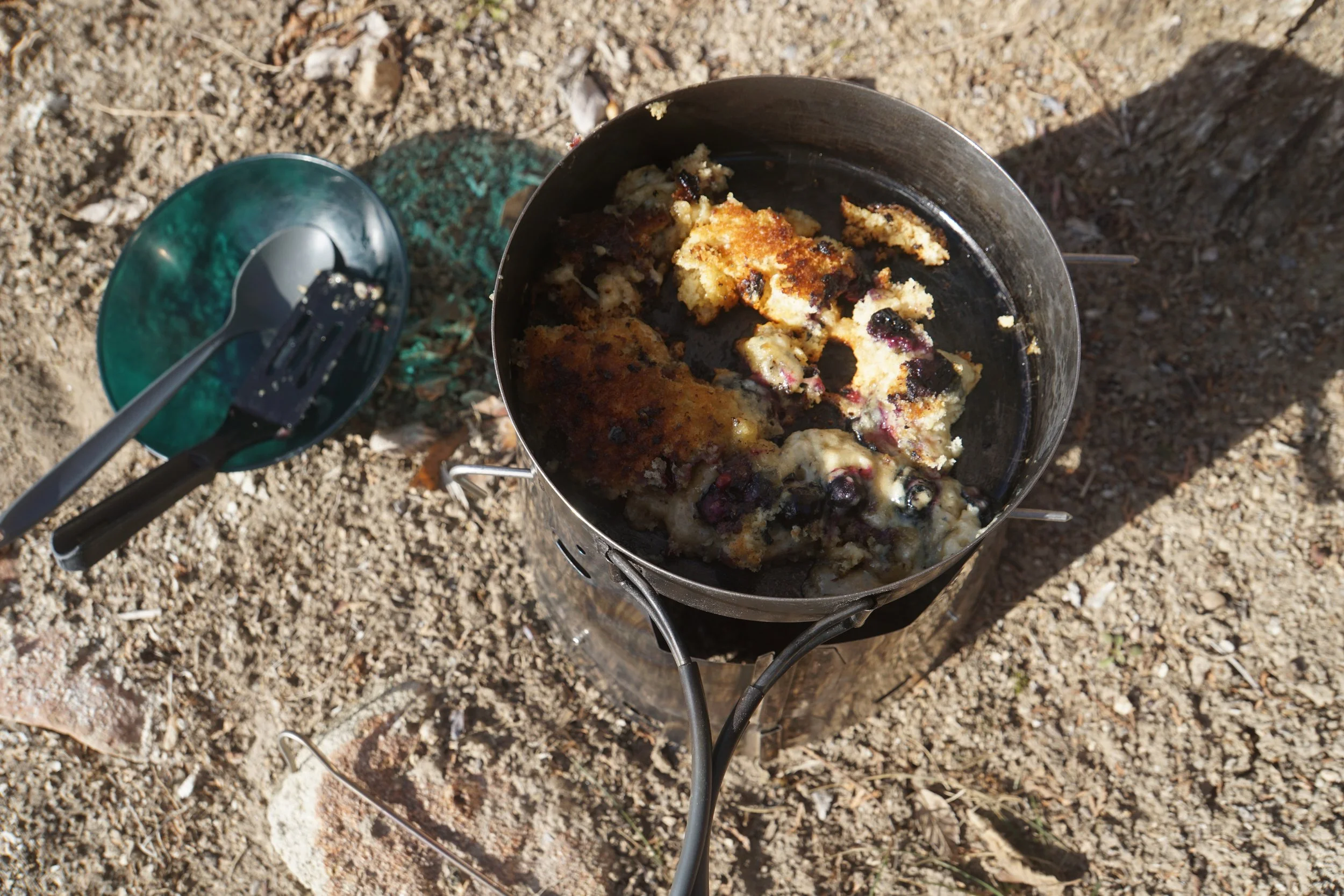
This is the biscuit that came out.  It was a little browned on the bottom, and perfectly cooked all the way through.  It was 30 minutes from starting the stove, to opening the pot to take out the biscuit.

Sawtooth 8 Day backpack

We had a great backpack in August of 2009, one we called the Sawtooth Slowpoke.  We hiked 42 miles, with sufficient elevation gain and loss to count as a 50 mile hike for Boy Scout purposes.  The backpack was from Petit Lake at the south of the range, to Sawtooth lake at the north of the range, which we hiked in 8 days, with one layover day.

Slowpoke RLS 001.p.23

Our first day we left Petit Lake and hiked past Farley Lake, to a small lake near the trail that cut off and headed to Edith Lake.  That night Erik and I got to get my new Ti Tri Caldera Cone, an alcohol stove system we would be using for the whole trip.  Erik and Barb taunted us with big fat steaks they had for dinner.  We were tired this day, and headed to bed early.

Slowpoke RLS 010.p.23

The next day we headed toward Edith Lake, and over a pass and then down toward Edna Lake. It was a bit cloudy all day, but never rained.  It was a wonderful day to hike.  My pack for this trip was 18 pounds without food and water, and with about 2 pounds of food per day, I ended up with about 40 pounds.  The REI Flash 65 pack did fine with this load.  Both Keven and I had this pack and it was brand new to me.

Slowpoke RLS 020.p.23

Kevin at Edith Lake.

Slowpoke RLS 039.p.23

Me and Barb near the pass to Edith Lake, with the White Cloud Peaks across the Stanley Valley behind us, with Farley Lake below us.  At Edna lake the boys had some good luck with fishing, and we all got as much fish to eat as we wanted.

Slowpoke RLS 054.p.23

We cooked fish using coals and wood inside the Caldera Cone.  It is made of thin titanium, and can use the alcohol stove, Esbits tablets, burning wood, or coals.

Slowpoke RLS 071.p.23

Edna Lake, from our camp the morning we headed for Cramer Lakes.  We hiked past long lake, and reached the scenic Cramer Divide about noon.

Slowpoke RLS 096.p.23

Malcolm, Jim, Kevin, and Joe on top of Cramer Divide.

Slowpoke RLS 104.p.23

The beautiful Cramer Lake.  From Cramer we headed to Flatrock Junction, then up the slope to Alpine Lake.  From Alpine, we headed over the pass to Barrett Lakes, where we camped at the lower Barret Lake.

Slowpoke RLS 156.p.23

Lower Barrett Lake.  From Barrett we headed down the trail for about 5 miles, and 2500′, then we headed up the trail about the same distance and elevation to Sawtooth Lake.  As we neared the top of the grade to Sawtooth Lake, we were walking along a rocky trail with Ginger my dog right behind me, and 3 hikers close behind me.  I saw a small Pika with a mouth full of grasses and leaves approaching.  I stopped, and everyone stopped, and the little Pika approached us down the trail.  When he got about 10 feet away he went around us on the rocks, and passed us going the other way.  I think it was a juvenile, and I’ll bet he got an earful from his Momma when he got home.  Here is the friendly Pike:

Slowpoke RLS 170.p.37

Finally, we got to our last lake, and the most spectacular lake in the Sawtooths, Sawtooth Lake.

Slowpoke RLS 178.p.23

This is Sawtooth Lake with Mt Reagan to the right.  We camped next to the small lake at the foot of Mt. Reagan.  We had a layover day here, and I hiked down to Trail Lakes.

Can You use an Alcohol Stove in the Winter?

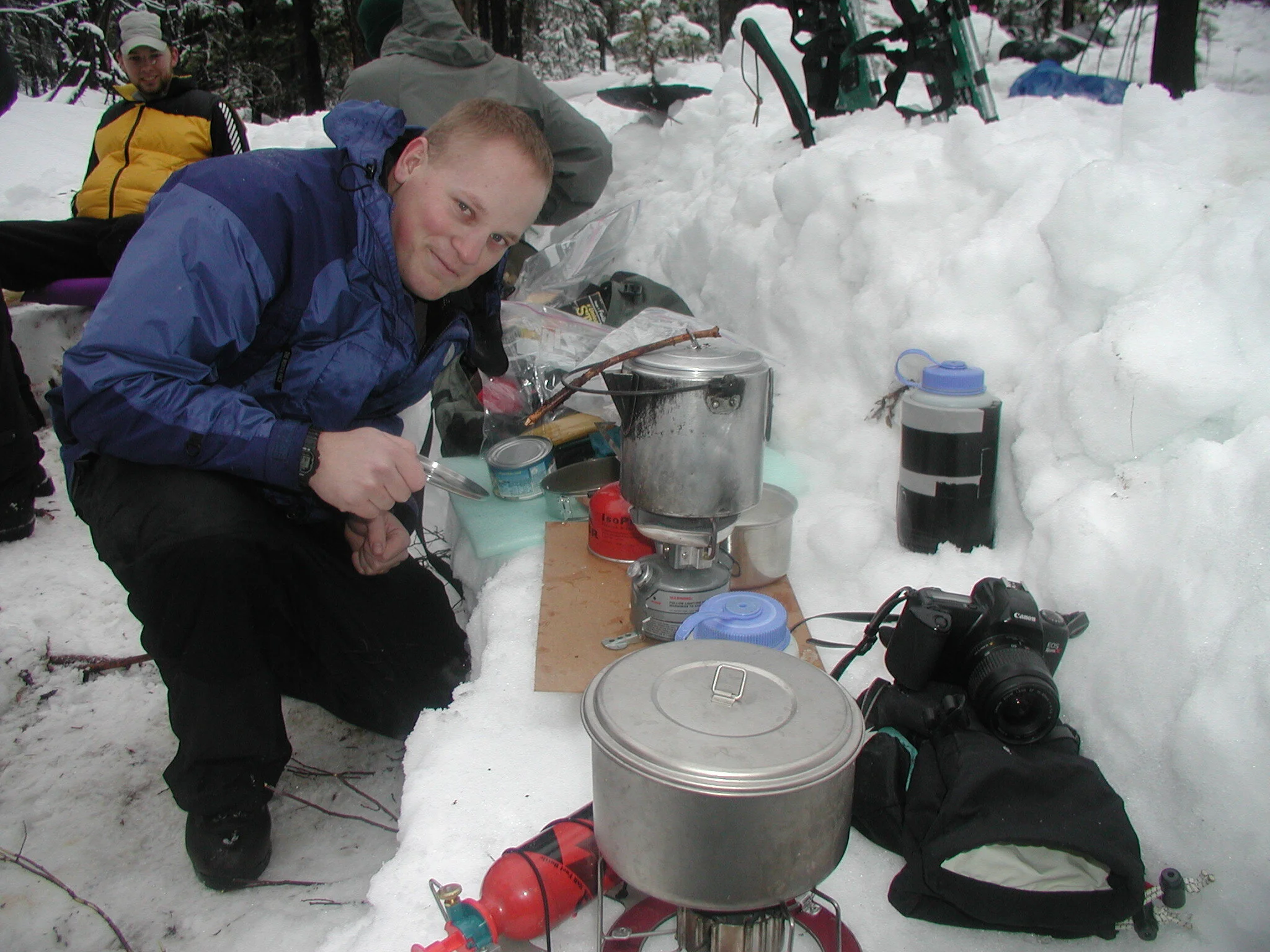
It is often assumed that you can’t use an alcohol stove in the winter, so I did a little test last weekend.  The scouts were going on a winter campout, so I took my Caldera Cone to test in winter conditions.  It was 21 degrees in the morning on Saturday, and the stove and fuel were stored outside my tent.   I put a bottle of water down on the snow as I cooked breakfast, and big ice crystals immediately began to form in the water.  It was cold!   I cooked frozen Jimmy Dean hash with bacon and fresh eggs, and made enough for 2 people.  Then I made a pot of hot water for coffee.

bsa winter camp 2010 003.23

I put the stove on some tent stakes as a platform to keep it from melting into the snow.  The stove is a lot closer to the pot than to the frying pan in this setup, so heating water is probably more efficient than frying frozen potatoes, but it had no trouble with frozen hash.  I think it would do fine melting snow to make water for 1 or 2  people as well, at this temperature.  I’ll test it at colder temperatures in a couple of weeks, if the weather cooperates.

Note: shortly after the trip described above, we went on another winter campout and I used the stove at 7 degrees F., and it worked fine.  It had to be started with a wooden match, and a tiny piece of paper in the primer ring with some fuel.  The paper burned, and got some fuel vaporizing, which heated the fuel  in the stove, and it was going strong within a minute.

Alice Toxaway Loop in Idaho

This summer a gang of Troop 100 scouts and their parents, and some family members, repeated our loop hike from Petit lake, to Farley Lake, to Toxaway Lake, over Snowyside Pass, and down to Alice Lake, and back to Petit Lake.  The previous two hikes of this route were thinly attended, but this year, participants added up to around 20.  That many people exceeds the maximum party size in the Sawtooths, so we split up the group and had one group do the loop clockwise, and one group do it counterclockwise.

Alice Toxaway RLS 021.5

I was with the older scouts, so our first stop was Alice Lake. 

Toxaway Alice 091.25

We laid over a day to enjoy the fishing and views at Alice, and headed over Snowyside Pass on the third day.   It was slow going and high elevations, but the view down to Twin Lakes was very nice.  We were also out of the mosquitoes so that was nice.

Alice Toxaway RLS 070.23

Alice Toxaway RLS 078

Our group got to the top of the pass first, and we sat around eating and waiting for the other half of our original party to come up from the other side.  They did, and we had a nice reunion.  They said the mosquitoes were about as bad at Toxaway as we had at Alice Lake.

Alice Toxaway RLS 091.23

After a snack we headed down to Toxaway Lake, and we found that our favorite camp site was available.  On the way we saw a lot of nice alpine buttercups.

Alice Toxaway RLS 113.23

Alice Toxaway RLS 142.23

The next day we hiked out past Farley Lake, and over the huge glacial morraine that separates Petit lake from Farley Lake.  That big hill seems to have gotten taller.  Last but not least appreciated, we hit the Bridge Tavern in upper Stanley for some awesome burgers and fries.

The Ti-Tri Caldera Cone – a field test

Having been a skeptic of alcohol stoves, I was pleasantly surprised with the Caldera Cone on a 5 day backpack in “cool to cold” weather, over spring break of 2009.  I used the aluminum version of the Caldera Cone on that trip, and cooked solo.  With cold mornings and occasional snowy conditions, the scouts compressed gas stoves were pretty punky, especially when they were half full or less.  The Caldera was reliable and immune to wind.

I got a Ti-Tri Caldera Cone before our 8 day backpack in the Sawtooths, along with an Evernew 1900ml pot and lid set.  This Caldera cone has a titanium cone windscreen, which supports the pot at the edge of the pot.  That way the pot bottom and sides are exposed to the heat of the stove, for fuel efficiency.  The Ti-Tri comes with a Gram Cracker esbit fuel holder, and since it is made of titanium, allows one to use wood as a fuel inside the cone.  Thus it works with three fuel types, hence the “tri” in the name.

titri-large

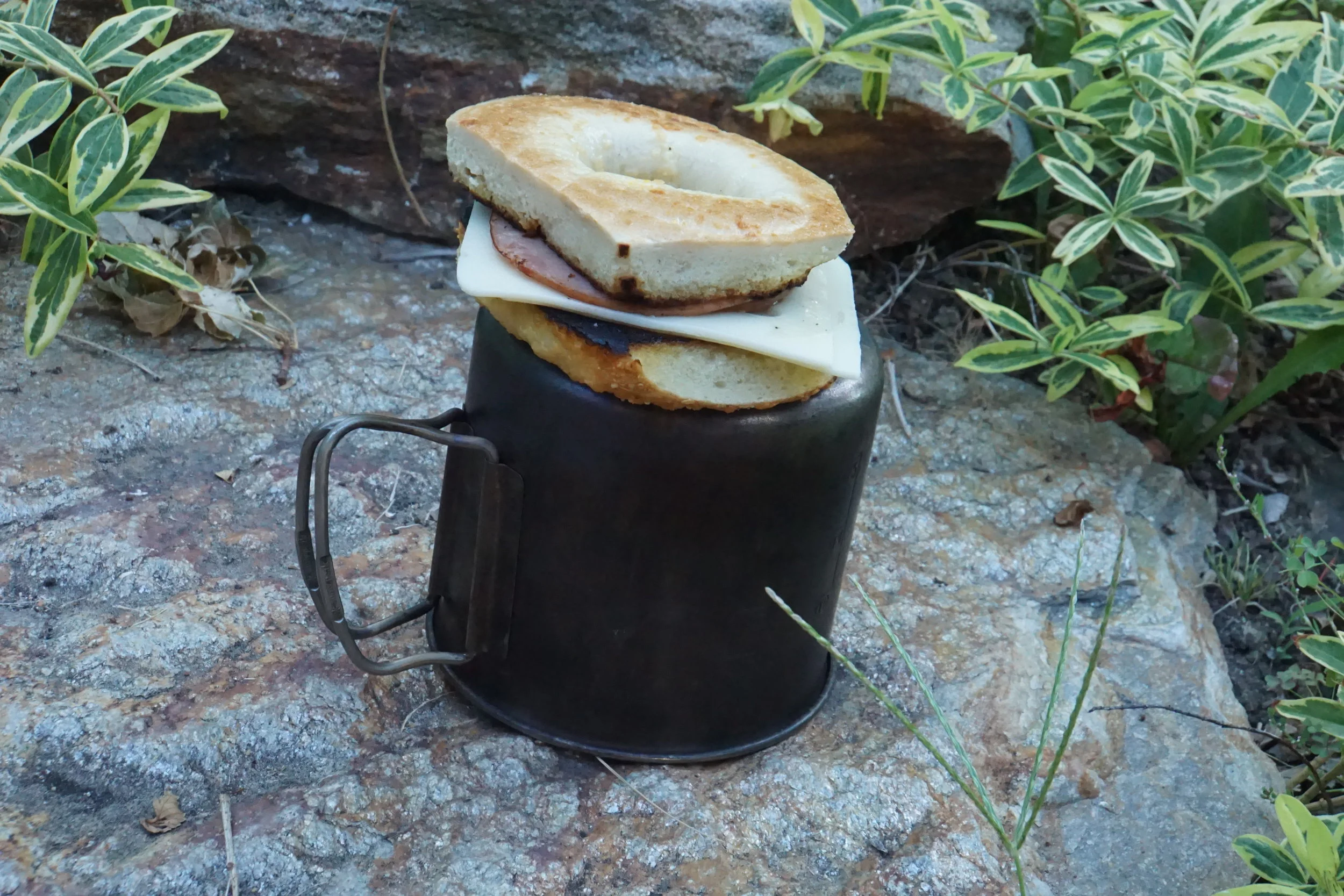
Our first dinner on the trail is shown below, with the cone and cookset clean and new. The stove was cooking for two adults, with dinners of rice, pasta, or one night we cooked pizza.  We were cooking breakfasts of bagels toasted in the fry pan, with Canadian bacon and cheese, or scones, and a few cups of coffee for me.

Slowpoke RLS 013.25

Our second night we caught the first fish of the trip, and tried the stove’s wood burning option.  A pair of titanium rods supports the fry pan or pot in this mode.  We put the cone in our coals from a campfire, and added small sticks to fry the fish.  The pot could handle one fish at a time, cut into sections.  They were delicious, and having the wood fuel option saved a bunch of fuel.

Slowpoke RLS 068.25

The final result of the trip was that it worked perfectly for two adults for an 8 day backpack.  One night our fellow hiker’s MSR Dragonfly clogged up, and we saved the day by finishing cooking their dinner on the Caldera.  So for our menu, which included actual cooking (not just heating water), for 7 dinners and 7 hot breakfasts, we used 24 oz of fuel.  The stove, windscreen and the plastic screw together caddy weighs 5.3 oz.  The Evernew cookset weighs 10.4 oz.  Both are sold at Trail Design.

Food plan for 8 day backpack

Here is a list of the evening meals we took on a recent 8 day backpack in the Sawtooths.  These meals are for 2 adults, and they were very tasty.  These taste better than freeze dried meals, are cheaper, and are less bulky.

Slowpoke RLS 057.25

Pasta with Pesto Sauce and Salmon Bits, from Prosecutor’s Cookbook

At Home:

Package in a quart ziplock freezer bag:

2-3 ounce foil pouches salmon

6 oz. (bundle of 10” pasta the diameter of a quarter) dry Angel Hair Spaghetti (broken after measuring to fit in your pot)

2 packages Knorr’s Pesto Sauce Powder

¼ cup (4 tsp) olive oil in a small plastic bottle

Put in a small snack sized ziplock bag or small coin envelope:

½ teaspoon garlic power

¼ teaspoon red pepper

½ teaspoon oregano

On the Trail:

Add 3 cups water to small one quart pot and bring to boil.  Add spaghetti and oil, then cook 3 minutes.   Add the rest of the ingredients, boil for one or two minutes, and serve.

SALMON PASTA, from Prosecutor’s Cookbook
At Home:

Package in a snack sized ziplock bag:

2 teaspoons granulated garlic

½ teaspoon crushed red pepper flakes

2 tablespoons dried shallots

4 tablespoons dried tomato bits

1 envelope or bullion cube of Herb-Ox Instant Chicken broth

Also bring: 7  ounces of  foil pouched salmon

Package 7 oz. angel hair pasta

Put in a small plastic bottle, 1 ½ ounces of capers

Place in a snack sized ziplock bag, ¼ cup parmesan cheese

Bring 2 ounces of olive oil in a small plastic bottle.

On the Trail:
Put the first snack sized ziplock bag of dried tomato and spices mixture into 18 ounces of water and reconstitute for 20 minutes.  Bring to boil, and add the angel hair past and boil for 4 to 5 minutes more, adding the olive oil and salmon near the end.


ISLE ROYALE SALMON, from Prosecutor’s Cookbook

While backpacking Isle Royale in Lake Superior this summer, I chatted with a fishing boat captain’s wife who was telling me how this was her 20th summer fishing with her husband at Isle Royale on Lake Superior. I asked her what she eats, and she said lots of fish, and that she knows more ways to cook fish than anyone. When I asked her what her favorite fish recipe was, she described “Isle Royale Salmon”. My heart began to race. Everything was available at the store, inexpensive, extremely light weight, quick to prepare on the trail.  In short, a perfect backpacking meal.  This recipe won first place in the Titanium Chef 2002 backpacking cooking contest.

At Home:
Package in a quart or half gallon ziplock bag  the following:

7 ounces of foil pouched salmon, (or smoked salmon)

In your first pint zip lock bag put:
1 package of Knorr Vegetable Soup, Dip & Recipe Mix

1 ounce dried sliced potato taken from a scalloped potato box
1/2 cup dehydrated onions
1 teaspoon chicken bullion
1/4 teaspoon ground thyme
1/4 teaspoon fresh ground white pepper
1/2 teaspoon salt (omit if using smoked salmon)

In a second pint zip lock bag put:
1 cup powdered milk
2 tablespoons flour
3/4 cup dehydrated mashed potatoes

Fill a third snack sized ziplock bag with small croutons.

On the Trail:

Bring 6 cups of water to a low boil.  Flake the fish and add to the boiling water with the first Ziplock bag of  pototo, onion, soup and spice mixture and cook at a low boil for another 10 minutes.  Turn off heat, and slowly add contents of second ziplock bag of powdered milkflour/potato mixture, stirring constantly.  When the flour is mixed in without lumps, turn on stove to a low simmer, and heat for 2 minutes.  Serve with small croutons.

CHICKEN TIKKA MASALA, from Prosecutor’s Cookbook


 This recipe is the recent  rage of Great Britain restaurants and has its origin in India.  Served with a gravy like chicken mixture over rice, this is a tasty way to eat chicken.


At Home:


Package in a snack freezer ziplock bag:

2 tbs. chopped dehydrated onions

¼ cup dried tomato bits

2 tbs. dried diced mushrooms

2 tsp. powdered milk

2 tsp. garam masala powder

1/8 tsp. dried lemon powder

½ tsp. ground white pepper

1 tsp. salt

½ tsp. ground cumin

½ tsp. coriander

½ tsp. turmeric

½ tsp. ginger powder

½ tsp. garlic

Package in a second snack sized ziplock bag:

1 cup instant rice.

½ cup dry unsalted shelled whole cashew nuts

Also bring:

1 seven ounce pouch package of Tyson’s Chicken

1 ounce canola oil

1  nan or a pita

Package all of the above in a quart ziplock bag.

On the Trail:

Add 1 cup water to your first snack bag of onions, tomatoes and spices and set aside to rehydrate.  Bring 1 cup of water to boil, add rice, and set aside for 5 minutes. Put your frypan on the stove, add canola oil, add chicken,, and simmer several minutes, then add the  rehydrated onions, tomatoes and spices from your first bag and simmer for several more minutes until the liquid is reduces to a gravy.  Pour chicken mixture over rice and serve. Eat with a nan or pita bread.


THAI CURRIED CHICKEN, from Prosecutor’s Cookbook


 The following recipe won Best Spicy Dish in the 2004 Titanium Chef Backpacking Cooking Contest.  Lightweight, simple, with ingredients that will keep on the trail, this dish can be made as hot as you want it.


At Home:


Package in a pint freezer ziplock bag:

¼ cup dehydrated carrots

¼ cup dehydrated chopped onions

¼ cup dehydrated corn

3 tablespoons dehydrated green peppers

3 tablespoons dehydrated sweet red peppers

1/3 cup rice

Package in a second ziplock snack sized bag:

1 60 gram package of Chao Brand Coconut Cream Powder

1 teaspoon curry powder for mild, 1 tablespoon for hot.

¼ teaspoon dried vinegar

1 teaspoon chicken bullion powder

½ teaspoon salt

Also bring:

1 seven ounce pouch package of Tyson’s Chicken

1 ounce olive oil

On the Trail:

Rehydrate contents of pint ziplock bag of vegetables in 4 cups water in a one liter pot and wait one hour.  Boil rice, rehydrated vegetables and olive oil for 15 minutes. Add second ziplock bag of spices and chicken during the last two minutes.


CRANBERRY CHICKEN AND RICE, from Prosecutor’s Cookbook


At Home:


Package in a quart ziplock bag:

Contents of a Knorr’s  Vegetable Recipe Mix

2 cups freeze dried chicken

2 teaspoons chicken bullion

½ teaspoon salt

2 teaspoons dried parsley

1 tablespoon dried minced onion

½ cup dried cranberries (craisins)

Package in a quart ziplock bag

3 cups instant rice

Package in a snack sized ziplock bag:

2 tablespoons of slivered almonds

On the Trail:

Except for the substitution of freeze dried chicken, this recipe is essentially one of my wife’s favorites taken from the cookbook Freezer Bag Cooking by Sarah Svien. Bring 6 cups of water to a boil, and add the first bag containing the freeze dried chicken.  Simmer for 20 minutes, adding the bag of instant rice during the last 5 minutes.  Add slivered almonds for the topping and serve.


Pizza Pan Biscuits, recipe from Sarah (Sarbar)

Serves 2, Prep time 15 minutes

Description

Ingredients

  • 1 c baking mix
  • 1 T Italian herb blend
  • 1?2 t diced dried garlic
  • 1?2 t ground black pepper
  • 2 T olive oil (or 2 packets)
  • 2 oz string cheese
  • 1 pkt shelf stable pepperoni slices (see notes)
  • 1?2 c water

Instructions

Pack the dry ingredients in a sandwich bag, seal tightly. Pack the oil, cheese and meat with it.

Cube up the cheese on a paper towel and separate the pepperoni slices. Add cool water to the bag and knead carefully till you have a dough. Add in the cheese and meat and knead till combined.

Depending on pan size you will want to do 1 or 2 batches. A pot set for 2L can handle the whole batch, if not split in half. If doing half batches, cut the oil in half.

In a non stick fry pan lid or wide/shallow pot heat half the oil on a medium flame. Add in the dough and pat out with the bag or a spatula/spoon. Cook till golden brown on the bottom, about 5 minutes. Adjust the flame as needed. If doing a large batch, drizzle the rest of the oil on top, then flip. To make it easier, you can use your spatula or spoon to cut sections before flipping. Cook for another 5 or so minutes or until golden brown and smelling super.

Notes

Bring single serving packets of shelf stable pizza sauce to dip in – find with the pre-baked pizza crusts. For the pepperoni, find often with deli meats, it does not need to be refrigerated till opened. Most brands have 2 separate inner packets. You will need one of them for this recipe.  For the cheese use whatever you like, from Mozzarella string cheese, to CoJack, cheddar, etc. 2 ounces is 2 sticks of prewrapped that carry well.  This is one recipe we could have eaten twice this quantity.

Spring Break Scout Hike: Grand Gulch in So. Utah

Troop/Crew 100 started the 2009 hiking season with a great 5 day backpack in southern Utah, in Grand Gulch.

We had 4 groups of participants, who started at 2 different trailheads, and camped at different campsites over a 5 day period.  Two groups started at Kane Gulch, and two started at Collins Springs.  The shortest route was 30 miles, and the longest was 50+ miles.  The route went through Kane Gulch and Grand Gulch, and for most parties their route included Bullet Canyon as an exit point.

Kane Gulch RLS 027

G

Grand Gulch and Bullet Canyon are lined on both sides by high cliff walls, with almost every south facing alcove hosting small Indian ruins and some rock art.  We visited Split Level Ruin, Turkey Pen Ruin, Jailhouse Ruin, and Perfect Kiva, and numerous smaller unmarked and unnamed ruins.   Many ruins were small food storage sites, built up with rocks and mortar, with a small door which could be sealed shut with a square stone door.  If the door was sealed up with a square rock and mud, the granary would be deer proof, mouse proof, and insect proof.

Kane Gulch RLS 040

The ruins were abandoned in 1300 AD en masse, as the inhabitants migrated to other areas.  Judging by the present availability of water, climate change must have been a reason for the migration.  The inhabitants are called Anazasi, and their descendents are the modern Zuni, Hopi, and Pueblo Indians.  The Navahos and Apaches appeared in the area around 1000 AD, and appear to have traded with the Anazasi, and sometimes conflicted with the Anazasi.  The Anazasi farmed corn, squash, and beans, and cooked in clay pots.  Corn cobs and stone flour grinders are present at many of the ruins.  In 200 BC beans were introduced to the area, which added a much needed protein source.  In 200 AD the technology of clay pots replaced the pitch coated woven baskets that were used to heat water.  The earlier culture was called the Basketmaker Culture, and their baskets and art was superior to the later Anazasi culture. The combination of beans and clay pots allowed the Anazasi’s food to be utilized more efficiently, which could have led to an increase in health and a population growth.

Kane Gulch RLS 116

During our trip, water was present in shallow pools, often 6 inches deep, 2 feet wide, and 6 feet long.  These were located about every 5 miles on average.  Compared to the clear mountain streams we are used to in Idaho, we would call these springs “mud holes,” but when there is no other water they looked pretty good.

Kane Gulch RLS 138

Our hike was in late March, and it was cool or cold in the shade, and the morning sun on our camp was always welcome warmth. My group was the younger scouts, and ours was a 30 mile route.  Nancy Baskin and Terry Heslin were with our group, and we all felt fortunate to have such fine company in such nice country.

Kane Gulch RLS 160

Kane Gulch RLS 162

Kane Gulch RLS 187This was an unnamed ruins that required crossing the canyon from the trail, getting through thick brambles, and climbing up a steep sandstone slope.  the boys climbed to the upper levels, and I felt a lot better when they were down on terra firma.

Kane Gulch RLS 209

This was a rebuilt kiva that can be visited at one of the ruins.  Inside is a dark dusty meeting room, and topside were dozens of sandstone corn grinders.  With every pound of corn meal the Indians consumed, I think they got an ounce of sand.  After 5 days in this canyon, we all felt that we were wearing, eating and carrying sand in everything.

Kane Gulch RLS 214Our last day was a climb up the rocks of Bullit Canyon, in which we reunited with some of our group that had been hiking a 50 mile route.  It was cold and windy that day, with a bit of spitting snow and cold breeze and we were in the shade most of the hike out.